
Outside Colorado? Get Free Shipping + No Sales Tax in Most States
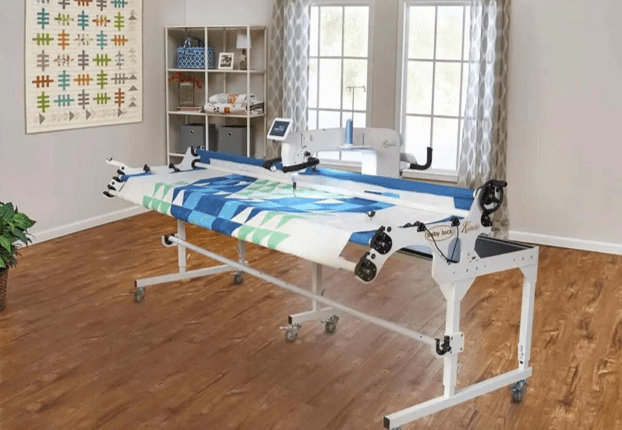
If you have been piecing quilts for a while and you are tired of wrestling king-size tops through a domestic machine, a long arm quilting machine might be the single best upgrade you ever make. A longarm gives you a larger throat space, a frame that holds the quilt flat, and the freedom to move the machine head instead of fighting with fabric. The result? Smoother stitches, faster finishing, and a whole lot less frustration.
Browse our full selection of longarm quilting machines and find the right fit for your space, your budget, and your quilting goals.
We have helped hundreds of quilters across Colorado choose their first (and second, and third) longarm. In this guide, we will walk you through the machines we trust most, explain what actually matters when you are comparing specs, and help you figure out which setup fits your quilting life. Whether you want a compact sit-down or a full-frame production system, we will cover it all.
A long arm quilting machine is a specialized sewing machine with an extended throat space (the distance between the needle and the body of the machine), typically ranging from 15 to 26 inches. That extra space lets you quilt large projects without folding, rolling, or cramming fabric under the arm. Most longarms mount on a frame that holds your quilt taut while you move the machine head across the surface, which is the opposite of how a domestic machine works.
Longarms come in two main configurations: stand-up models that sit on a floor frame and sit-down models that fit into a table-based setup. Stand-up machines offer maximum reach and speed, while sit-down models save floor space and feel more familiar to sewers who are used to working at a table. Both give you a major step up from quilting on a standard sewing machine.
Five years ago, most home quilters considered a longarm a “someday” purchase. That has changed. Frame designs have gotten more compact, pricing has become more accessible, and sit-down options now deliver real longarm performance in a space that fits a spare bedroom.
Here is what actually drives the switch:
Before you start comparing models, get clear on a few key factors. These will narrow your choices fast and keep you from overspending on features you will not use (or underspending on ones you will wish you had).
Throat space is measured in inches from the needle to the machine body. More throat space means more room to maneuver and quilt larger sections in a single pass. For home quilters, 15 to 18 inches is a solid starting point. If you plan to quilt for others or tackle king-size quilts regularly, look at 20 inches or more.
A built-in stitch regulator adjusts the needle speed to match how fast you move the machine. This keeps your stitches uniform, even when you slow down for detail work or speed up on straight runs. If you are investing in a longarm, stitch regulation is worth every penny.
Frames range from tabletop setups to full 10-foot and 12-foot floor frames. Measure your space before you shop. A 10-foot frame needs a room that is at least 12 feet long so you can walk around it comfortably. Many manufacturers also offer 5-foot and 8-foot frame options that work well in smaller rooms.
Manual longarms are hands-on: you guide the machine head yourself for free-motion quilting and ruler work. Computerized systems (like Pro-Stitcher or QuiltMotion) let you load digital designs and have the machine stitch them automatically. Manual machines cost less and many quilters prefer the creative control. Computerized setups save time on repetitive patterns and edge-to-edge designs.
Entry-level sit-down longarms start around $4,500 to $5,000 with a frame. Mid-range stand-up systems with a stitch regulator and frame run $8,000 to $15,000. Professional-grade machines with computerized quilting start around $20,000 and go up from there. Remember that financing options can make even a higher-end machine manageable: we offer flexible payment plans on all our longarms.
Not sure where to start? Visit any of our four Colorado locations and try these machines hands-on before you decide.
We carry longarms from Handi Quilter, Baby Lock, Janome, and Grace Company. Each brand takes a different approach, and the “best” machine depends entirely on your space, your goals, and your quilting style. Here is how the top models stack up.
The Handi Quilter Moxie is one of the most popular first longarms for home quilters, and for good reason. It has a 15-inch throat space, a reliable stitch regulator, and comes with multiple frame options (Little Foot, 8-Foot Loft, or 10-Foot Loft) so you can match it to your room size. Starting at $4,595 with a frame, the Moxie hits a price point that makes longarm quilting realistic for hobbyists who are ready to move up from a domestic machine.
What we hear from quilters who buy the Moxie: it is smooth, quiet, and forgiving for beginners. The handles are comfortable during long sessions, and the stitch quality is consistent right out of the box. If you want to start with free-motion quilting and ruler work without a steep learning curve, the Moxie is a strong first choice.
If floor space is tight or you prefer quilting while seated, the Handi Quilter Moxie ST puts true longarm performance in a sit-down package. At $5,595, it gives you the same stitch quality as the stand-up Moxie but in a table-based setup that fits into a sewing room or even a large closet. The 15-inch throat space is generous for a sit-down machine, and the stitch regulator works just as well at slow creative speeds as it does on longer runs.
The Moxie ST is a favorite among quilters who already have an established sewing space and do not want to rearrange their entire room for a floor frame. It is also a smart pick for quilters with back or knee issues who want to avoid standing for hours.
The Janome Quilt Maker 15 is an outstanding value at $4,995, especially when you factor in the included accessories package (a $531 value). It features a 15-inch throat space, adjustable speed up to 1,600 stitches per minute, and a built-in stitch regulator. Janome has a long track record of building reliable machines with tight tolerances, and the Quilt Maker 15 carries that reputation into the longarm category.
This machine appeals to quilters who want a no-fuss setup that produces clean, even stitches. The included accessories kit means you can start quilting immediately instead of shopping for add-ons. If you value reliability and a complete out-of-the-box package, the Quilt Maker 15 deserves a close look.
The Baby Lock Gallant pairs a 15-inch throat with an 8-foot Villa Frame and a stitch regulator that quilters describe as “butter smooth,” especially at slow speeds. Where the Gallant stands out is in detailed, creative work. It handles frequent starts and stops without skipped stitches, making it ideal for free-motion artists and quilters who love ruler work. You can also upgrade the Gallant with Pro-Stitcher Lite if you want to dip your toes into computerized quilting down the road.
Baby Lock machines come with something that is hard to put a price on: a strong support network. As an authorized Baby Lock dealer, we offer free lifetime machine instruction classes with every purchase. That ongoing training is a real advantage when you are learning a new type of machine.
The Baby Lock Regalia is built for quilters who want to finish more quilts in less time. Its 20-inch throat space gives you room to quilt large sections without repositioning, and the machine handles speeds up to 2,500 stitches per minute with steady, even tension. The Regalia integrates with Pro-Stitcher automation software, which means you can load edge-to-edge designs and let the machine do the work while you prep your next project.
This is the machine we recommend for quilters who are thinking about quilting for friends, guild members, or even starting a small quilting business from home. The combination of speed, throat space, and computerized capability makes it a true production machine in a home-friendly package.
Grace Company takes a modular approach with the Q’nique series. The Q’nique 16X (available in Manual and Elite versions) and Q’nique 19X Elite give you 16 to 19 inches of throat space and pair with Grace’s own frame systems, including adjustable-length options. This modularity is a real advantage if you want to start with a smaller frame and upgrade later without replacing the machine itself.
Grace also offers the QuiltMotion QCT6 computerized system, which can be added to their machines for automated quilting. And if you are not ready for a dedicated longarm but want to expand your quilting capability, the Grace Mini Quilter (on sale at $299.95, originally $399) turns many standard sewing machines into a frame-based quilting setup.
Ready to see these machines in person? Stop by our Arvada, Aurora, Littleton, or Colorado Springs store and test-drive the one that interests you most.
| Machine | Throat Space | Type | Stitch Regulation | Automation Option | Starting Price | Best For |
|---|---|---|---|---|---|---|
| Handi Quilter Moxie | 15″ | Stand-up | Yes | Pro-Stitcher compatible | $4,595 | First-time longarm buyers |
| Handi Quilter Moxie ST | 15″ | Sit-down | Yes | No | $5,595 | Small spaces, seated quilting |
| Janome Quilt Maker 15 | 15″ | Stand-up | Yes | No | $4,995 | Value-conscious quilters |
| Baby Lock Gallant | 15″ | Stand-up | Yes | Pro-Stitcher Lite upgrade | Contact for pricing | Creative free-motion work |
| Baby Lock Regalia | 20″ | Stand-up | Yes | Pro-Stitcher included | Contact for pricing | Production quilting |
| Grace Q’nique 16X | 16″ | Stand-up | Yes (Elite model) | QuiltMotion QCT6 add-on | Contact for pricing | Modular frame flexibility |
| Grace Q’nique 19X Elite | 19″ | Stand-up | Yes | QuiltMotion QCT6 add-on | Contact for pricing | Larger quilt capacity |
One of the biggest concerns we hear from home quilters is, “Will it actually fit in my house?” The short answer: probably yes, but you need to plan ahead.
If you buy a longarm from us, our technicians can walk you through the full setup process and make sure your frame is level and your tension is dialed in before you start your first quilt. We also offer longarm quilting classes at all four locations to help you build confidence with your new machine.
A stitch regulator is a sensor system that adjusts needle speed based on how fast you move the machine. When you slow down for tight curves, the needle slows down too. When you speed up on a straight line, the needle keeps pace. The result is consistent stitch length across your entire quilt, regardless of how steady your hands are.
For new longarm quilters, a stitch regulator removes one of the steepest parts of the learning curve. Instead of training your hands to maintain a constant speed (which takes months of practice), you can focus on your design and let the regulator handle the stitching mechanics.
Every machine in our recommended list above includes a stitch regulator or offers one as standard equipment. We consider it a must-have feature for home quilters.
This is one of the most common questions we get at the shop, and there is no single right answer. It depends on what kind of quilting you enjoy most.
Choose manual if you:
Choose computerized if you:
Many quilters start manual and add a computerized system later. Machines like the Baby Lock Gallant and Grace Q’nique series are designed with this upgrade path in mind, so you are not locked into one approach.
Home longarm quilting machines start around $4,500 for an entry-level stand-up or sit-down model with a frame. Mid-range systems with larger throat space and stitch regulation typically run $8,000 to $15,000. Professional machines with computerized quilting capability start around $20,000. Financing options are available to spread the cost over time.
A full 10-foot frame requires a room at least 12 feet long and 6 feet wide. Smaller 5-foot and 8-foot frames fit in more compact spaces. Sit-down longarm machines like the Handi Quilter Moxie ST need about the same floor space as a large desk, making them practical for apartment-size sewing rooms.
Yes, but hands-on instruction speeds up the learning process. Most quilters feel comfortable with basic free-motion quilting within a few weeks of regular practice. At Rocky Mountain Sewing and Vacuum, every machine purchase includes free lifetime machine instruction classes, so you always have expert support as you build your skills.
Throat space is the main difference. Mid-arm machines typically have 12 to 15 inches of throat space, while longarms range from 15 to 26 inches. Longarms also tend to be faster, offer stitch regulation as standard, and mount on dedicated frames. A mid-arm on a frame (like the Grace Mini Quilter setup) can be a good stepping stone if you are not ready for a full longarm investment.
You do not need a dedicated room, but a consistent setup space helps. Many of our customers quilt in spare bedrooms, finished basements, and even large garages. The key requirements are a level floor, adequate lighting, and enough room to move around the frame comfortably.
Choosing a longarm is a big decision, and there is no substitute for sitting down at a machine, moving the handles, and seeing how it feels. We keep longarms from Handi Quilter, Baby Lock, Janome, and Grace set up and threaded at our stores so you can test them side by side.
Visit Rocky Mountain Sewing and Vacuum at our Arvada, Aurora, Littleton, or Colorado Springs location. Our team will help you find the longarm quilting machine that fits your space, your budget, and your creative vision.
Already own a longarm and need it serviced? Our factory-trained technicians work on all brands, whether you bought it from us or not. And if you want to sharpen your skills, check our class schedule for upcoming longarm quilting workshops near you.